
📌 Summary: Korea Post’s 2026 K-Packet Pricing Issue
-
Korea Post suspended international registered small packages with just one day’s notice, effective January 1, 2026.
-
As a replacement, K-Packet was expanded to 31 new countries, mostly in Europe.
-
For newly added countries (e.g. Austria, Belgium), K-Packet rates are up to 2.4× higher than for existing destinations (e.g. Germany, France).
-
In some cases, K-Packet is even more expensive than EMS, a premium service.
-
By contrast, Japan Post applied identical pricing to newly added countries under the same UPU 2026 framework—highlighting the abnormality of Korea Post’s approach.
A One-Day Notice for a Years-Long Policy Change
Korea Post announced that it would cease accepting international registered small packages starting January 1, 2026.
The notice was issued on December 30, 2025.
This is not a typo.
The announcement was made just one day before the service termination.
What makes this more serious is that this suspension was neither sudden nor unforeseeable.
It had already been discussed and formally adopted at the 2023 Riyadh General Assembly of the Universal Postal Union (UPU), with the implementation date clearly set for 2026.
In other words, Korea Post had at least several years to prepare sellers and customers.
Instead, Korean sellers were informed only one day before the deadline.
Many sellers likely accepted international orders without knowing that one of their core shipping methods was about to disappear.
The “Expansion” That Made Things Worse
On January 14, 2026, Korea Post announced that it would expand K-Packet acceptance from 20 countries to 51, adding 31 new destinations, as a replacement for the suspended international registered small package service.
The new rate structure took effect on January 23, 2026.
Once again, the announcement prompted an exclamation of “Korea Post!”—an expression of dismay, not admiration.
Let us examine why the rates for these newly added countries are indefensible.
Germany vs Austria: Where the Numbers Stop Making Sense
Germany, one of the original 20 K-Packet destinations, and Austria, a newly added country, are neighboring countries.
Mail sent from outside Europe to these destinations typically shares similar logistics routes, hubs, and cost structures. Unsurprisingly, EMS rates from Korea to Germany and Austria are nearly identical.
The problem lies entirely with Austria’s new K-Packet rates.
The following table shows the complete K-Packet rate structure, which makes the issue immediately obvious.
Full K-Packet Rate Comparison
Germany vs Austria (January 2026 exchange rate)
K-Packet maximum weight: 2.0 kg / Base rates only
(Exchange rate reference: approx. €1 = ₩1,711)
| Weight | Germany (€) | Germany (KRW) | Austria (€) | Austria (KRW) |
|---|---|---|---|---|
| 0.1 kg | 3.18 | 5,450 | 2.65 | 4,530 |
| 0.2 kg | 4.15 | 7,100 | 4.64 | 7,940 |
| 0.3 kg | 5.13 | 8,770 | 6.64 | 11,360 |
| 0.4 kg | 6.09 | 10,420 | 8.63 | 14,770 |
| 0.5 kg | 7.07 | 12,090 | 10.63 | 18,180 |
| 0.6 kg | 7.83 | 13,390 | 12.62 | 21,600 |
| 0.7 kg | 8.57 | 14,670 | 14.62 | 25,010 |
| 0.8 kg | 9.32 | 15,950 | 16.61 | 28,420 |
| 0.9 kg | 10.08 | 17,250 | 18.61 | 31,840 |
| 1.0 kg | 10.84 | 18,550 | 20.60 | 35,250 |
| 1.1 kg | 11.43 | 19,560 | 22.59 | 38,660 |
| 1.2 kg | 12.01 | 20,560 | 24.59 | 42,080 |
| 1.3 kg | 12.60 | 21,570 | 26.59 | 45,490 |
| 1.4 kg | 13.19 | 22,580 | 28.58 | 48,900 |
| 1.5 kg | 13.78 | 23,590 | 31.16 | 53,320 |
| 1.6 kg | 14.37 | 24,590 | 32.57 | 55,730 |
| 1.7 kg | 14.96 | 25,600 | 34.56 | 59,140 |
| 1.8 kg | 15.55 | 26,610 | 36.56 | 62,560 |
| 1.9 kg | 16.13 | 27,610 | 38.55 | 65,970 |
| 2.0 kg | 16.72 | 28,620 | 40.53 | 69,380 |
What This Table Shows
- Germany’s K-Packet rates increase gradually, flattening above 1 kg at roughly €0.58 (≈ ₩1,000) per step.
- Austria’s rates increase by about €1.99 (≈ ₩3,400) at every single weight bracket, from start to finish.
- At 2.0 kg, Austria’s K-Packet rate is 2.4× higher than Germany’s, despite the two countries sharing logistics routes.
K-Packet vs EMS (2.0 kg)
| Country | EMS (€) | EMS (KRW) |
|---|---|---|
| Germany | 25.41 | 43,500 |
| Austria | 24.83 | 42,500 |
➡ Austria’s K-Packet rate (€40.53 / ₩69,380) is ~1.6× more expensive than EMS, a premium service that is faster and more reliable.
To put this into perspective, Austria’s 2.0 kg K-Packet rate is comparable to the EMS rate for a shipment of approximately 5.5 kg.
France vs Belgium Shows the Same Problem
France was part of the original K-Packet 20 countries, while Belgium is a newly added destination.
0.1 kg
-
France: €3.22 / ₩5,510
-
Belgium: €2.66 / ₩4,560
2.0 kg
-
France: €16.56 / ₩28,350
-
Belgium: €40.90 / ₩70,020
EMS (2.0 kg)
-
France: €21.34 / ₩36,500
-
Belgium: €24.83 / ₩42,500
Once again, K-Packet pricing for a newly added country exceeds EMS, directly contradicting the product’s stated purpose.
To be clear, Austria and Belgium are not isolated cases.
They are used here because they offer the clearest side-by-side comparisons with neighboring countries that share the same logistics routes and infrastructure.
The underlying issue is structural:
across newly added destinations, K-Packet rates follow a fundamentally different—and significantly more expensive—pricing curve than those applied to existing countries.
How Other Countries Handled the Same Transition
Japan Post faced the same UPU 2026 requirement.
On November 20, 2025, Japan Post announced that, starting January 1, 2026, e-Packet Light (Japan’s equivalent of K-Packet) would expand from 40 countries to 138 countries.
The announcement was made more than one month in advance.
All rates were published beforehand.
And critically, newly added countries were priced at the same level as existing destinations.
For example, Germany, France, Austria, and Belgium—the same countries discussed above—all fall under a single European rate group in Japan’s e-Packet Light system.
Every weight bracket from 0.1 kg to 2.0 kg is priced identically across all four countries, regardless of whether they were part of the original 40 destinations or newly added.
Source:
https://www.post.japanpost.jp/notification/pressrelease/2025/00_honsha/1120_01_01.pdf
Korea Post had access to the same timeline, the same UPU guidelines, and the same international postal infrastructure.
Instead, Korea Post:
-
Announced the expansion just one day before implementation
-
Priced newly added countries up to 2.4× higher than existing destinations
-
Set rates that exceed EMS, directly contradicting the product’s stated purpose
The contrast is not subtle.
“It’s Not a Mistake”
Assuming there must be an error, I contacted Korea Post Headquarters.
Their response was that the rates were correct and based on a “thorough review of actual costs.”
When asked why neighboring countries such as Germany and Austria showed such drastic differences, the representative claimed that shipping volume differs, naturally resulting in different costs.
This claim is directly contradicted by Japan Post’s approach, which integrated 98 newly added countries into existing rate zones without any cost differentiation.
This explanation falls apart even under minimal scrutiny.
Germany and Austria share logistics routes and international hubs.
If Austria truly incurred higher costs, its base 0.1 kg rate should have been higher from the outset, which it is not.
Moreover, this explanation fails to account for why EMS rates remain virtually identical between the two countries.
In short, the representative either lacked basic knowledge of international postal logistics or knowingly lied to the user.
“K-Packet Doesn’t Have to Be Cheaper”
When asked how a service explicitly positioned as a lower-tier, cost-saving alternative to EMS could exceed EMS pricing beyond 1 kg, the response was:
“K-Packet doesn’t necessarily have to be cheaper.”
That response amounts to dereliction of duty.
Korea Post has consistently described K-Packet as
“an international postal service dedicated to small items, introduced to alleviate export logistics costs for e-commerce companies,”
and has repeatedly emphasized that it is 30–40% cheaper than EMS.
Either Korea Post does not understand the product it manages, does not understand its own pricing structure, or is knowingly misleading users to justify an indefensible pricing table.
Formal Complaints Filed
After concluding that further discussion with headquarters was pointless, I consulted my local post office manager.
The response was:
“This rate is normal. What exactly is the problem?”
I also filed a complaint through the National Petition Portal, only to find that the case was handled by an official affiliated with Korea Post itself.
I have now submitted formal complaints to the Board of Audit and Inspection and the National Assembly, and am awaiting their responses.
Final Note to Overseas K-Pop Fans
Regardless of how this process concludes, one point is clear:
Korea Post bears full responsibility for this situation.
Overseas K-pop fans should not direct their frustration at Korean sellers, who were placed in this position by administrative negligence.
This is not a matter of choice, but of feasibility.
Offering K-Packet at prices that exceed EMS contradicts the service’s purpose and, in our view, presents customers with a misleading option.
Accordingly, we are unable to offer K-Packet shipping to the 31 newly added countries until a consistent and reasonable pricing structure is introduced.
Finally, I would like to pose one question.
Are the postal services of these countries aware of this pricing structure?
For example, if the Belgian postal service charges €30 for a 2 kg international parcel sent to Japan, yet charges €80 for the same 2 kg parcel sent to Korea, would the Korean government or Korea Post accept this as a normal pricing structure?
International postal rates are not something each country determines entirely independently and then leaves unquestioned.
Structurally unexplained rate differences inevitably become subjects of mutual inquiry and review.
If you are a user in any of these 31 newly added countries, I strongly encourage you to contact your national postal service and ask whether such pricing discrepancies are considered normal under international postal frameworks.
This is not about doing Korea a favor.
It is about questioning why you, as a customer, are being charged rates that exceed even a premium EMS service.
The 31 newly added K-Packet destinations are:
Argentina, Austria, Belarus, Belgium, Cambodia, Chile, Egypt, Finland, Honduras, India, Ireland, Israel, Italy, Kazakhstan, Kyrgyzstan, Mexico, Mongolia, Nepal, Netherlands, Norway, Pakistan, Peru, Poland, Saudi Arabia, South Africa, Sweden, Switzerland, Türkiye, Ukraine, UAE, Uzbekistan
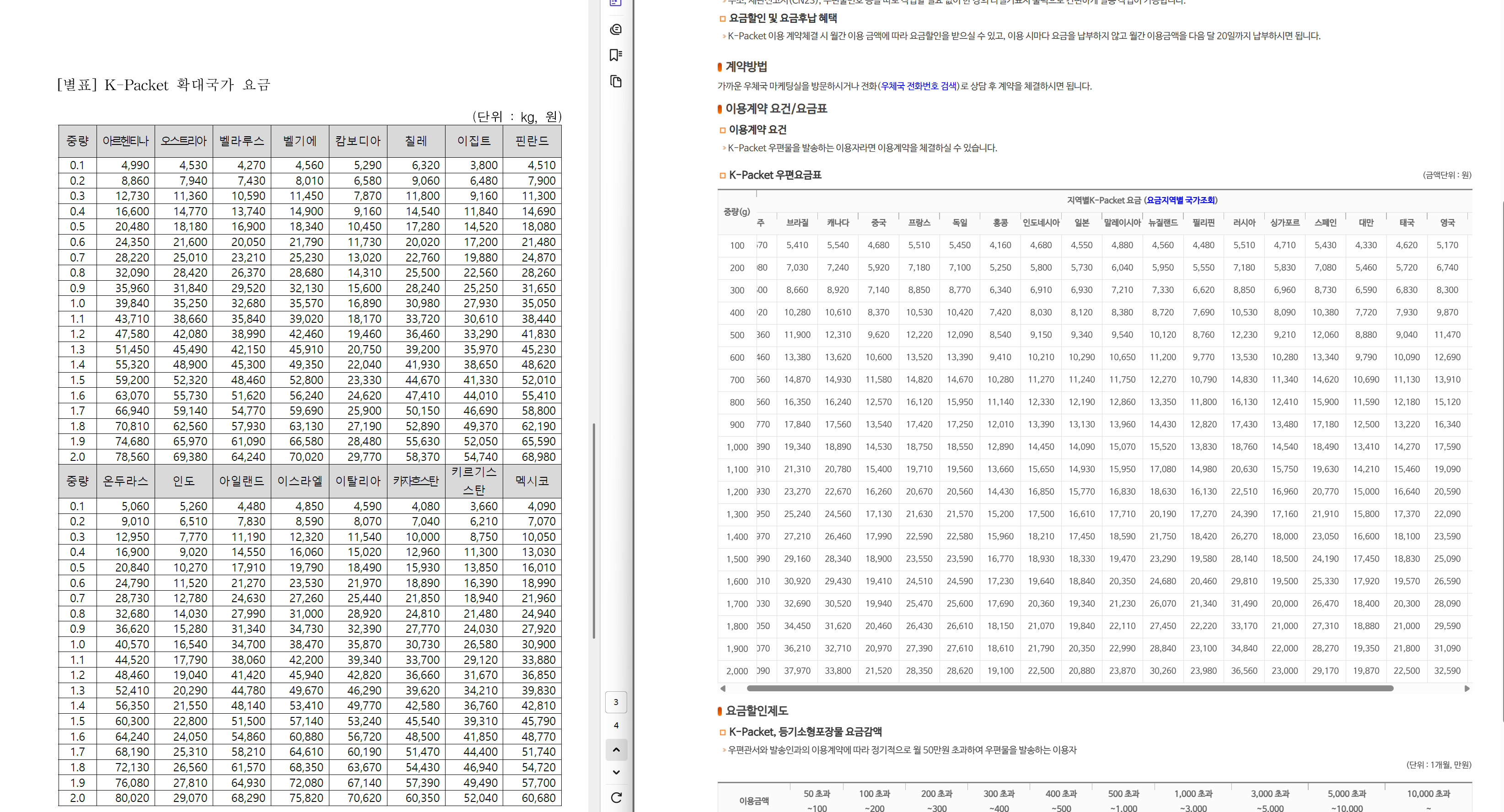
Below is a comparison of the new and previous K-Packet rate tables.
The left side shows the rates for the 31 newly added countries, while the right side shows the rates for the original 20 K-Packet destinations.
Even without understanding Korean, the problem becomes immediately apparent.
Official document (PDF)
K-Packet Destination Expansion – Pilot Implementation Notice
Original Korea Post document (Korean). Provided for reference and free download.
